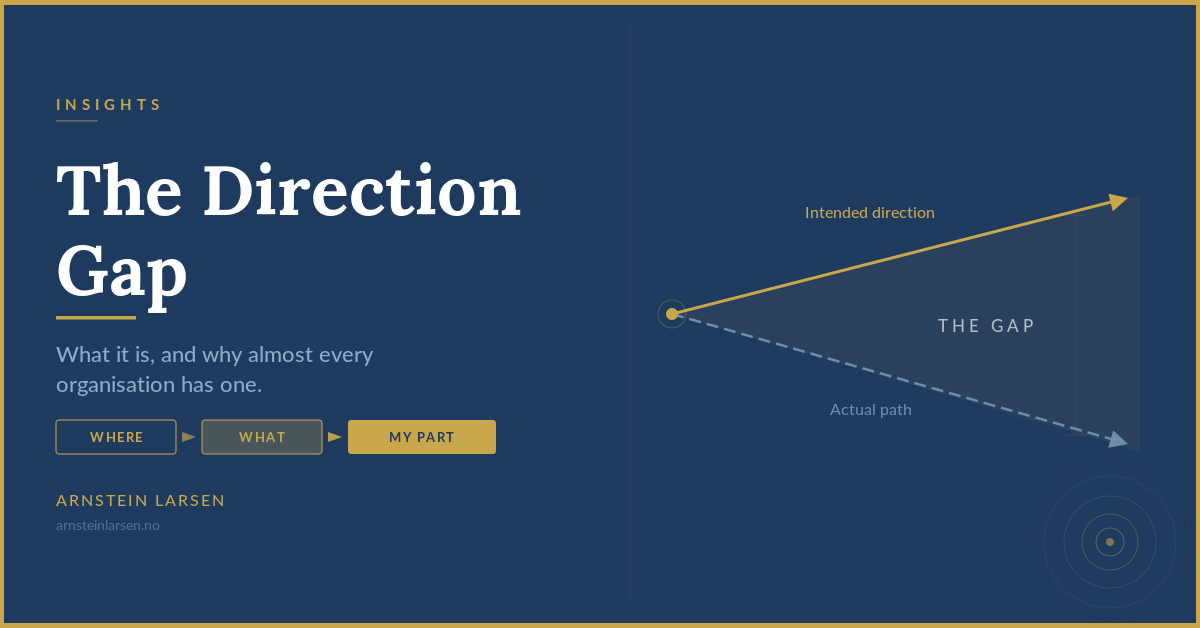
The direction gap is the distance between what an organisation says it’s going to do, and what it actually does.
It’s not about bad employees or incompetent leadership. It’s about something far more ordinary: how easy it is to work hard in the wrong direction.
You’ve seen it. The team is productive — meetings, deliverables, reports, tasks. But when you step back and ask “is any of this actually moving us where we need to go?”, the answer is often vague. Or silent.
The direction gap is not a sign of failure. It’s a structural phenomenon that emerges in every organisation that grows, changes, or has more than one layer of management.
Three reasons the direction gap appears
1. The strategy lives in presentations, not in daily work
Most strategies are born at an offsite, polished in PowerPoint and shared at an all-hands meeting. Then everyday life resumes — and the presentation goes into a folder.
The problem isn’t that the strategy is bad. The problem is that it was never translated into something people can act on by Tuesday morning. A direction that hasn’t been operationalised is just a wish.
2. Everyone agrees on the goal — but not on what it means in practice
“We want to be our customers’ preferred partner.” Great. But what does that mean for the sales team versus the support team versus product development? Interpreted differently across three departments, you get three different sets of priorities — and a gap nobody sees, because everyone believes they’re working towards the same thing.
High-level strategic alignment often conceals deeper disagreement about what actually needs to be done.
3. Ownership stops at the top
Leaders set the direction. Middle managers translate it. Employees do the work. But in many organisations, the real sense of ownership ends somewhere in the hierarchy — and further down, people live in their task lists, disconnected from the bigger picture.
When “my part” isn’t clearly linked to “our direction”, the direction gap is inevitable.
Why it’s hard to see
The dangerous thing about the direction gap is that it’s invisible day to day. Everyone is busy. Everyone is delivering something.
It only surfaces when you ask simple questions:
- What are the three most important things the organisation is working towards right now?
- What are you working on today — and how does it contribute to where we’re going?
- What would you prioritise differently if you knew that time was your only scarce resource?
The answers are often surprising. Not because people don’t care, but because the connection between direction and daily work was never built clearly enough.
Three levels where the gap can appear
After working with many organisations through advisory and board roles, I’ve found that the direction gap almost always appears at one of three levels:
WHERE — the strategic direction. The organisation doesn’t have a clear enough sense of where it’s heading. Or those who do haven’t communicated it in a way that actually sticks.
WHAT — the operational priorities. The direction is known, but it hasn’t been broken down into concrete priorities at team and individual level. Everyone agrees, but nobody knows what to stop doing.
MY PART — personal ownership. Direction and priorities are in place, but the individual employee doesn’t have a clear and meaningful answer to their role in the whole picture.
Identify which level holds the biggest gap — and you know where to start.
What do you do about it?
There’s no magic solution, but there is a framework. In my e-book The Direction Gap, I’ve laid out a five-step system for diagnosing, closing and maintaining direction in an organisation — without launching a new strategy project or bringing in another round of consultants.
The starting point is always the same: acknowledge that the gap exists. Ask the simple questions. Listen to the answers without defending them.
It’s harder than it sounds. And more important than you might think.
📩 Download the free guide and start to find the direction gap in your organisation.

Arnstein Larsen
Arnstein Larsen is an advisor, board chair and interim executive specialising in strategy, leadership and organisational development. He helps organisations turn strategy into something people actually work by — not just something that lives in presentations. Arnstein serves as chairman of Primafon AS, board member of JSAN Consulting AS, and runs the advisory firm LAKI. He is the author of The Direction Gap, a practical guide for leaders who want to close the gap between strategy and everyday work.